Returned immigrants, how many of them become employers? About 91% of returned immigrants who are self-employed work without paid employees.


Some returning emigrants try to create economic activity, but entrepreneurship still remains limited and mostly small-scale. Data from the 2024 Household Migration Survey show that self-employment is one of the main routes to economic reintegration for returning emigrants, however, businesses that create jobs for others are few.
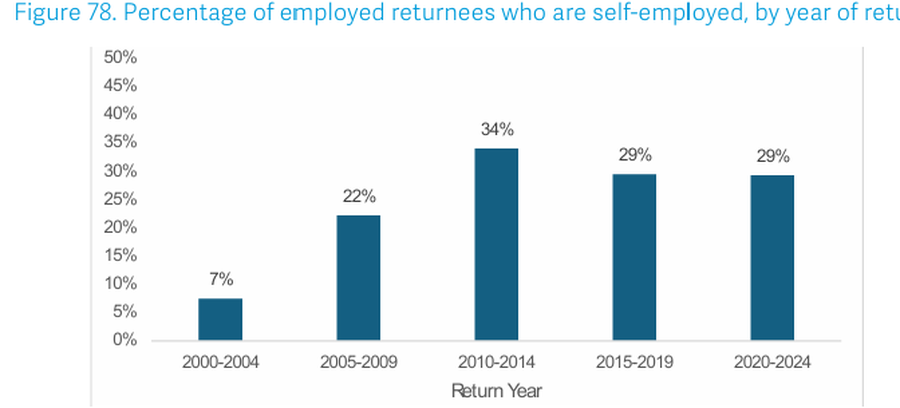
According to the report, the self-employment rate among returning emigrants has increased significantly over the years. From around 7% for those who returned in 2000-2004, this rate reached 34% for returnees in the period 2010-2014, while for the most recent groups, 2015-2024, it is estimated at around 29%. This shows that more and more returnees are turning to independent economic activity as a way to generate income.
However, most of these activities are very small businesses. The report highlights that 91-93% of self-employed returnees work without paid employees, which means that they are mainly individual self-employment and not job-generating enterprises.
Women often choose self-employment as an alternative
The data also show differences by gender. In some cases, female returnees show higher rates of self-employment than men, especially when they face difficulties in finding paid work. For example, for early returnees, 41% of women are self-employed, compared to 25% of men. For other groups, the differences are smaller, but self-employment remains an important option for both genders.
Returning immigrants are more likely to become entrepreneurs
Although the number of businesses with employees remains low, the report highlights a slight advantage for returned emigrants. They are about 0.8 percentage points more likely to become employers than people who have not emigrated. This effect increases for those who have stayed abroad longer, indicating that the experience gained in emigration can have a positive impact on the creation of economic activity upon return.

Albanian, an educational priority through certification and standardization - Kumbaro: We need a National Agency for the language
During the panel dedicated to the Albanian language “Standardization and Certification of the Albanian Language in the Diaspora”, Minister of Education......

More phones and social networks than inhabitants! In parallel, the audience for Facebook ads also increased
At the end of 2025, there were about 3.4 million mobile connections in Albania, a figure that at first glance seems very high compared to the country's......

Changes in the Law on Citizenship - Balla: Passports can be obtained by individuals with a contribution
The Parliamentary Committee for Europe and Foreign Affairs has approved several additions and amendments to the Law "On Citizenship". The initiator of this......

Oil price drops to 207 lek/liter, Transparency Board publishes new prices
The Transparency Board decided to reduce fuel prices at its meeting held on April 15, 2026, reflecting fluctuations in international markets. According to......

Diaspora as a supporting partner for EU integration - Dhuka: You are the experts on European standards, we need you
In the panel focusing on the Albanian diaspora as a supporting partner for European integration and sustainable development, Chief Negotiator Majlinda Dhuka......

Where are pensioners investing in Albania? Living costs remain low, but the dilemma between renting and buying persists
Albania is becoming one of the countries where foreign retirees choose to live, due to its many amenities and low cost of living. Also, the beauty of the......

Electronic platform for energy trading - 300 million lek investment of the Albanian Energy Exchange
The Albanian Electricity Exchange, ALPEX, has announced the opening of the competition for the construction of electronic trading and clearing platforms for......
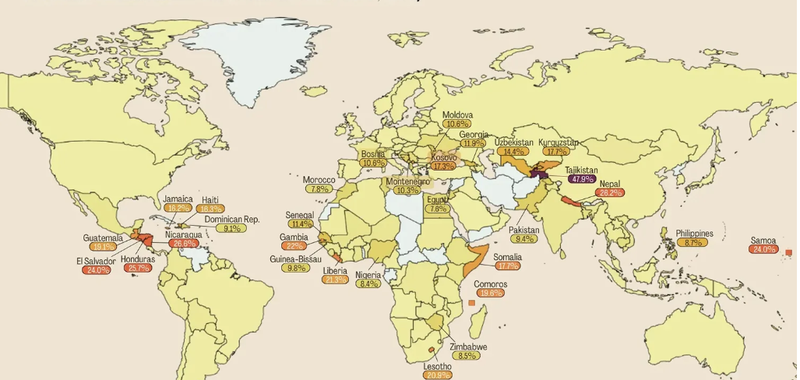
Albania vs Kosovo, how dependent are we on remittances? Visual Capitalist: We rank 36th and 16th out of 194 economies in total
Remittances continue to be one of the most stable sources of income for many economies in the world, especially for countries with high levels of emigration.......