Individuals pay with cards, businesses still with checks/ Who is really pushing the digitalization of payments in Albania?

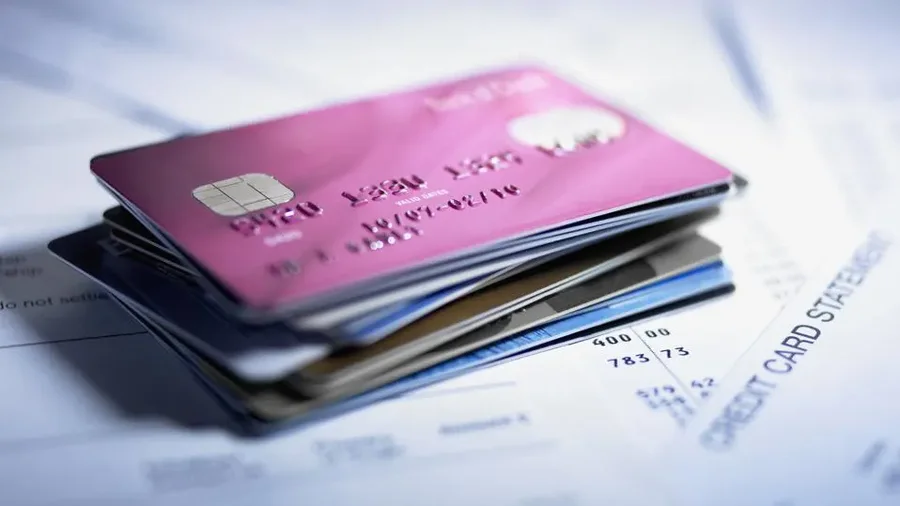
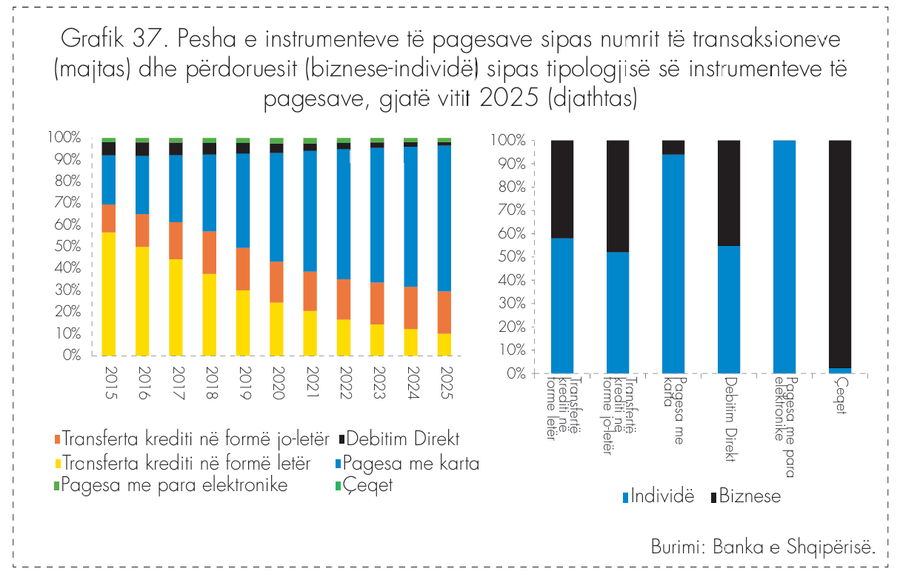
Individuals are pushing the Albanian banking system towards digital payments, while businesses continue to remain more tied to traditional instruments. This is the picture that emerges from the Bank of Albania's 2025 annual report, according to which cards have become the dominant means of payment, while checks remain almost entirely in business use.
The data from the report shows that in the last decade the weight of paper transfers has continuously decreased, while card payments have risen to the leading position in the payment structure. At the same time, the division between users is clear, cards and electronic money are dominated by individuals, while checks remain essentially a business instrument.
According to the report, around 67% of the total number of payments through banks during 2025 were made with debit and credit cards, while 94% of card payments belong to individuals. Similarly, electronic money payments are used only by individuals, making this instrument the clearest sign of the digital consumer.
The report shows that the change is not only in the instrument, but also in the channel of use. Home banking applications are now offered by all banks, while 66% of credit transfers are carried out remotely. During 2025, the number of payments through home banking increased by 23.2%, while remotely accessible accounts expanded by 44.4%, reaching 46.8% of total customer accounts in banks.
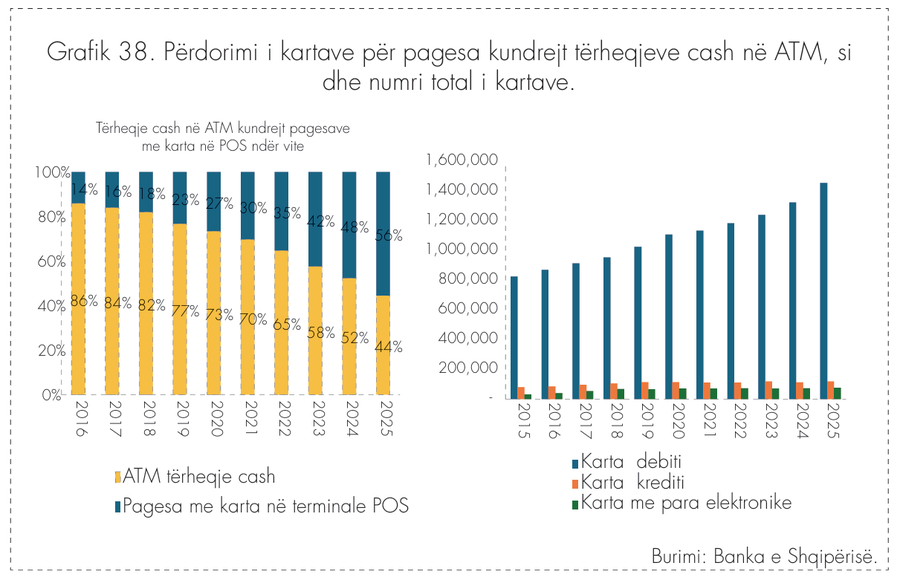
Another strong signal of this shift is the use of cards no longer as a means of cash withdrawal, but as a payment instrument. The Bank of Albania emphasizes that during 2025, for the first time, cards were used mainly for making payments, breaking the previous model of their use mainly for cash withdrawals. The number of card payments increased by 27.5%, while their use at POS in the country expanded by 38.7% in number and 26.9% in value.

Smart work and a 4-day week/ Which countries are preparing to face the energy crisis?
Oil prices are rising above $110 per barrel in the markets, pushing up fuel costs. The specter of austerity is starting to appear in Europe, while in many......
The fleet of electric vehicles is growing - In the first two months of the year, over 1,700 were registered
The electric vehicle fleet in the country is growing. This is also evidenced by data showing an interest on the part of citizens in environmentally friendly......
9.1% of Portuguese people work almost 50 hours/week - Fourth place in the EU where the average is calculated at 6.5%
Portugal ranks fourth in the European Union for the share of professionals who regularly work 49 hours or more per week in their main job. The figure, which......
Investment for the road traffic electrical network - OSSH, finances 94 million lek for the intelligent system
The Regional Directorate of OSSH Tirana has announced the opening of the tender for the construction of a cable line for the supply of electricity to the......

General decline in the foreign exchange market – Major currencies weaken significantly
The US dollar has started the week in a significant decline, suffering a decrease in value from the previous week, as it was bought today at 82.2 lek and......
Romanian government reduces oil excise duty - "Solidarity tax" on extraordinary profits of companies starts from April 7
The Romanian government has approved an emergency decree to temporarily reduce excise duty on standard crude oil and introduce a "solidarity tax" on windfall......

Oil prices continue to rise - US-Israeli war with Iran is damaging supply
Oil prices were little changed in Monday's trade as investors awaited clarification on the status of talks between the U.S. and Iran, although they remained......
Budget revenues at record level - Rama: Over 1 billion euros more without increasing taxes
Prime Minister Edi Rama has declared that budget revenues have reached a historic level, reflecting, according to him, the strengthening of the Albanian......