Investment Council Meeting/ Ibrahimaj: Entry into the EU market requires harmonization with European standards.

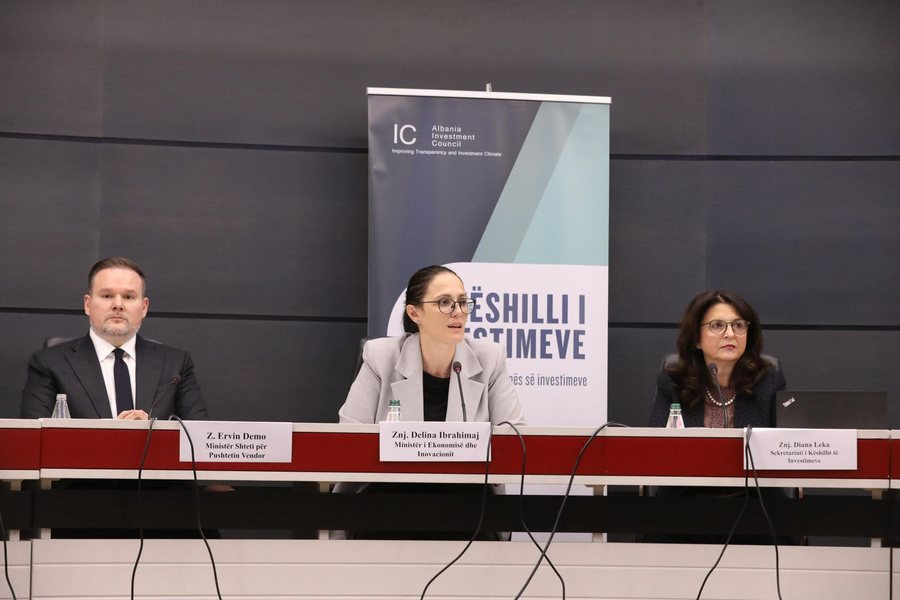
The Minister of Economy and Innovation, Delina Ibrahimaj, chaired the next meeting of the Investment Council, where business expectations on the digitalization of local services and the relevant draft recommendations were presented, the findings of the 2015–2025 survey on the investment climate with a focus on interaction with the tax administration and the challenges of entering the common market, as well as suggestions on the Council's work plan for 2026.
The Minister expressed the maximum commitment of the MEI towards fulfilling the tasks, especially the process of approximating legislation with that of the EU in the field of economy and business support.
"There are criteria, standards, requirements, that will have to be implemented by Albanian business, the Albanian economy, and this represents a great challenge for all of you, all of us. But it also represents a great opportunity," said Ibrahimaj.
The Minister highlighted several issues during the meeting, such as:
· the importance of unifying and modernizing local services,
· the need for high transparency, establishing measurable indicators and sustainable central and local coordination,
· the commitment to improving the fiscal environment and increasing business confidence.
Meanwhile, in the main priorities for 2026, the Minister highlighted:
· Digitalization of local services
· Strengthening the tax administration
· Support for SMEs in the European transition process
· Approval of the recommendations of the Investment Council as a basis for work for 2026.
The Ministry also informed about several initiatives undertaken by the MEI in terms of formalization, more systematic information and reconfirmed the commitment to continue reforms that increase transparency, reduce costs for businesses and promote a more modern, more competitive and aligned investment climate with European Union standards.
This meeting was also attended by the Minister of State for Local Government, Ervin Demo, who assessed that the digitalization of services by Municipalities will bring an improvement in their services for entrepreneurship and citizens, although it is a process that takes time.
The meeting was attended by representatives of central and local institutions, representatives of domestic and foreign businesses that develop their economic activity in our country.
Annex 1. Digitalization of local services - main findings The analysis conducted with the participation of 166 businesses and municipalities shows that the landscape of business access to local digital services remains fragmented and not unified with central services, while municipalities face limited technical capacities and a lack of clear performance indicators. Businesses remain positive towards digitalization and integration but require: 1. simplification and standardization of services, 2. reduction of physical contact, 3. comprehensive consultation and greater transparency on taxes and local decision-making. During this meeting, it was emphasized that the Fiscal Cadastre is not functioning, despite the existing legal basis. Recommendations for 2026 include: · establishing measurable performance indicators for municipal services, · harmonizing local services with central ones, · mandatory data exchange between the GDT and municipalities, · support for SMEs in the adoption of digital services. Investment climate, survey findings (188 businesses) National survey (188 entities) 2015-2025 highlights some positive developments, but also important challenges: Tax Administration 1. Improvement in communication and professionalism. 2. Clearer tax reporting. 3. Increase in appeal decisions in favor of businesses. 4. Digital systems are significantly better evaluated from 2022, but entities still require telephone contact VAT - Refund 1. 90% of companies that apply receive a refund. 2. Increase in automatic refund. 3. Only half of businesses apply, due to the perception of lack of trust. Informality 1. 7 out of 10 companies perceive it as high and stable. 2. Main forms: tax avoidance and undeclared work.
3. Driving factors: corruption and unfair competition.
EU Integration
1. Only 33% of businesses have sufficient information on the Reform Agenda.
2. 70% see integration as positive.
3. Only 30% expect exports to increase without additional support.
4. They hope for greater inclusiveness in consultation

English as a second language - Which EU country speaks it best?
The Dutch have been named the world's best English-speaking foreign language speakers for the seventh time in a row, according to a new study, even though......

How did this week end for the major currencies?
The US dollar closed this week negatively after losing points again this morning, just like the day before, being bought today at 82.5 lek and being sold at......

Real incomes lower than in 2009 - Greek families benefit less than before the crisis
Real incomes of Greek households remain 15% lower than in 2009, before the financial crisis erupted and Greece entered the memorandum adventure. Despite the......

Mandatory reserves to avoid crisis - Serbian government decision, after the closure of the NIS oil refinery
Serbia is finalizing an action plan outlining steps to introduce mandatory reserves of oil derivatives on the market after its sole refiner, the......

"There are jobs, but there are no professionals" - The same refrain in North Macedonia
The paradox of the labor market in North Macedonia is becoming more and more apparent every year, with high unemployment on the one hand and thousands of job......

Meta, under the EU's "magnifier" - The company will be investigated for the use of AI in Whatsapp
Brussels has launched a new investigation into Meta Platforms over how the company deployed artificial intelligence functions on WhatsApp, the European......

Pensioner bonus, Rama: In the first 3 days, 96,292 citizens withdrew the benefit
In the first 3 days, 96,292 pensioners have withdrawn the end-of-year benefit, also known as the pensioner bonus. The figure was published on his social......
"Cashless Albania 2030", initiative aims to increase the use of digital payments by citizens and businesses
Albania is taking steps towards an increasingly digital economy, through a national program that aims to facilitate payments for citizens and businesses and......