"There are jobs, but there are no professionals" - The same refrain in North Macedonia


The paradox of the labor market in North Macedonia is becoming more and more apparent every year, with high unemployment on the one hand and thousands of job vacancies on the other. Data from the State Statistical Office for the third quarter show that 10,033 job vacancies were registered, with a rate of 2.02%, although hundreds of thousands of people remain unemployed.
Referring to the figures, the largest number of vacancies is in the processing industry, which registers 103,821 filled positions, but still requires labor. At the same time, the largest group of vacancies 2,052 falls on elementary professions. This clearly signals that the market is looking for workers for basic, manual, technical professions, while a part of the unemployed is looking for work that matches their formal education or higher claims for administrative positions.
In this regard, unemployment is not just a lack of work, but often a lack of the right skills. Thousands of people do not possess the technical training required in the processing industry, food services, or certain trades. Vocational education remains undervalued and underdeveloped, producing generations with diplomas but limited practical skills.
The accommodation and food service sector has the highest job vacancy rate at 3.69%, perhaps because this sector has low wages, long hours, and stressful conditions. Many citizens prefer to wait longer for a better job, emigrate, or remain in the informal economy, rather than work in conditions that do not offer economic dignity.
Employers' demand for "experienced" workers, but offering minimum wages, further deepens this gap or discrepancy. Job seekers are unwilling to accept a low-wage job, while employers are often unwilling to offer better conditions.
North Macedonia has one of the highest rates of labor migration in the region. Many of those with the most sought-after skills—craftsmen, chefs, technicians, manufacturing workers, and even doctors—leave for EU countries for higher wages and more stable conditions.
This trend leaves the country with a shortage of workers in key sectors and produces the paradoxical effect of increasing vacancies while the quality of the labor supply declines.
The country's economy is still heavily reliant on sectors such as manufacturing and food services, which do not generate high wages. Innovation, high technology, and creative industries are underdeveloped. As a result, the country produces many jobs but few well-paid ones, creating dissatisfaction and resistance among job seekers.
State policies also play a role. Training programs are often not coordinated with real market needs, while there is a lack of vocational guidance in schools and a distance between education and industry.

Meta, under the EU's "magnifier" - The company will be investigated for the use of AI in Whatsapp
Brussels has launched a new investigation into Meta Platforms over how the company deployed artificial intelligence functions on WhatsApp, the European......

Pensioner bonus, Rama: In the first 3 days, 96,292 citizens withdrew the benefit
In the first 3 days, 96,292 pensioners have withdrawn the end-of-year benefit, also known as the pensioner bonus. The figure was published on his social......
"Cashless Albania 2030", initiative aims to increase the use of digital payments by citizens and businesses
Albania is taking steps towards an increasingly digital economy, through a national program that aims to facilitate payments for citizens and businesses and......
Loans for the Durrës-Rrogozhina railway, Malaj: Strategic investment for international connections
The Parliament is expected to approve today two loan agreements and a grant agreement for the financing of one of the most important railway projects, namely......

KESH's solar photovoltaic park in Belsh, the guarantee agreement passes to the Parliament
Minister of Finance Petrit Malaj has asked the deputies in the Assembly to approve the guarantee agreement with the EBRD for the construction of a solar......
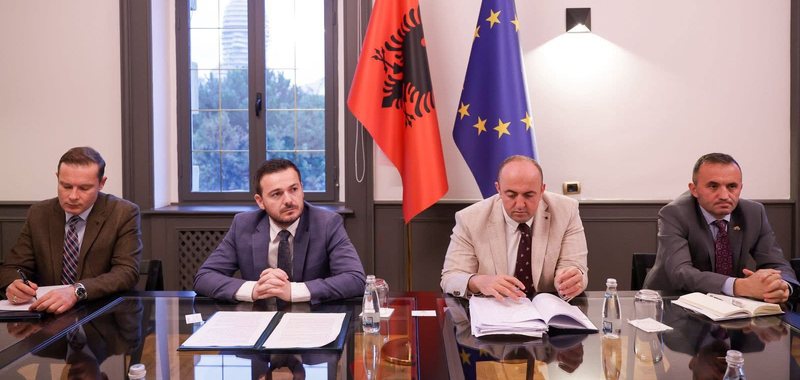
Minister Salla meets with World Bank representatives on the progress of the CRAD project
The Minister of Agriculture and Rural Development, Mr. Andis Salla, held a working meeting today with Mr. Sameh Naguib Wahba, Regional Director of the Planet......

Teenagers, facing technology - Is blocking social networks a solution?
The use of social networks by teenagers has become a global problem. Many countries are trying to ban them for minors, by setting age limits. The latest is......

What are the four priorities of regional trade? - Albania takes the lead of CEFTA in 2026
Albania is expected to take over the CEFTA Presidency in 2026. But what is CEFTA? The Central European Free Trade Agreement (CEFTA) is a regional mechanism......