"Courts cannot dismiss ministers" - Rama cites Venice for Balluk's suspension by the GJKKO

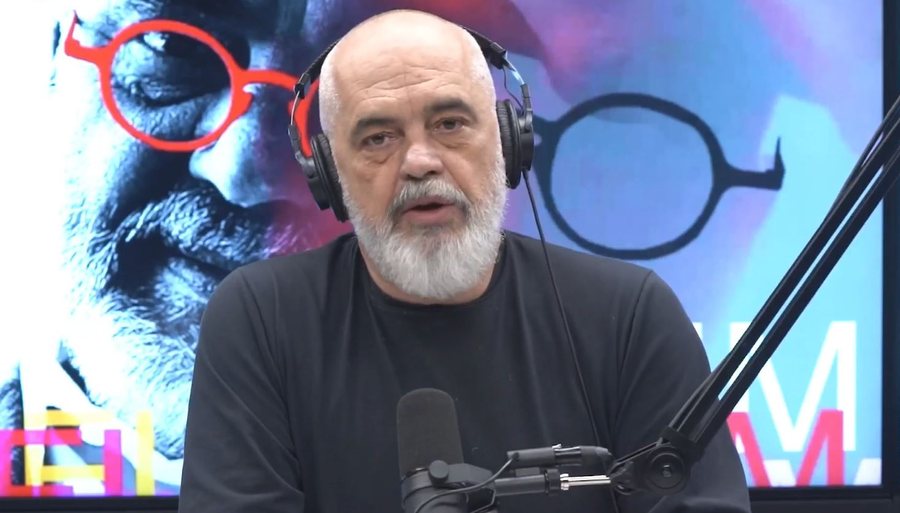
Prime Minister Edi Rama, in his weekly podcast, has commented again on the decision of the Constitutional Court to suspend Belinda Balluku from her position as Deputy Prime Minister and Minister of Infrastructure and Energy. Prime Minister Rama has brought to attention what the Venice Commission and the European Court of Strasbourg have to say about this issue.
"Courts should NOT suspend members of the government, because by doing so they violate the balance of powers. As long as a minister is a political figure, part of the executive, responsible to the Parliament and the Prime Minister, if the court suspends him, it practically: interferes in the work of the government, changes the composition of the executive and takes powers that belong to the Prime Minister and the President ," Rama said. This is considered by Venice to be an impermissible violation of the dividing line between powers.
Rama further argues that by taking such actions, the courts create the possibility of instrumentalizing justice, and Venice often warns against "judicial overreach", or in Albanian, the extension of the judiciary's arm beyond the dividing line with politics, because this consequently paves the way for political pressures on the government, institutional destabilization, and manipulation of the executive through criminal processes.
And thirdly, ministers have political, not administrative, functions, and Venice has said it many times: “Suspension measures apply to civil servants, not to members of the government, because the minister is not an 'administrative official', but a political authority.
Rama's full reaction:
A fierce debate has filled the void of the week's media and social media clubs, after a prosecutor and a judge teamed up, head-to-head, to suspend a member of the government cabinet.
I do not want to enter into any debate about such a dangerous absurdity as this and I wait patiently for the Constitutional Court to give direction to the issue of this path untrodden anywhere in Europe, and as far as we have been informed so far, nowhere in the world.
But I wanted to share with you today what the Venice Commission and the European Court of Strasbourg say about this issue.
Venice's position is actually very clear.
Courts should NOT suspend members of the government, because by doing so:
First, they violate the balance of power.
As long as a minister is a political figure, part of the executive, accountable to Parliament and the Prime Minister, if the court suspends him, it practically:
• interferes with the work of the government,
• changes the composition of the executive,
• assumes powers that belong to the Prime Minister and the President.
And this is considered by Venice to be an impermissible violation of the dividing line between powers.
Secondly, by doing so, courts create the possibility of instrumentalizing justice, and Venice often warns against "judicial overreach", or in Albanian, the extension of the judiciary's arm beyond the dividing line with politics, because this consequently paves the way for:
• political pressures on the government,
• institutional destabilization,
• manipulation of the executive through criminal processes.
Third, ministers have political, not administrative, functions, and Venice has said it many times:
The suspension measures apply to civil servants, not to members of the government, because the minister is not an "administrative official", but a political authority.
Finally, the judicial suspension of a minister is de facto pressure for his dismissal, since when a minister is suspended, it is not an individual who is suspended, but rather the entire decision-making process for one or more sectors that the minister may cover is paralyzed. And this is completely unconstitutional.
The Venice Commission has expressly emphasized:
“One of the principles of parliamentary democracy is that the government can only be dismissed by political bodies, not by judicial bodies.”
What does the European Court of Strasbourg say about this issue?
This is interesting. The European Court has never encountered this absurdity and therefore has never issued any specific decision mentioning the phrase “suspension of the minister by the court”!
Why? Because in no European country has it ever happened that a prosecutor and a judge would come together, face to face in the dark, and suspend a minister.
So, once again, what a prosecutor and a judge have done in Albania, by suspending a member of the government cabinet, is an unheard of attempt, an unprecedented experiment, an idea never developed before and, apparently, an unimagined path anywhere else that could be trodden by the judiciary, to take over the powers of the Prime Minister, the President, and the Parliament together.
But there are some very clear principles of the European Court that fundamentally prohibit this anti-democratic adventure:
First, Strasbourg says that security measures cannot be used:
• for political purposes,
• out of proportion,
• and to influence the executive.
The suspension of a minister from office is minimally disproportionate and directly affects the executive.
Secondly, for Strasbourg, ministers are an expression of democratic will: the government stems from the parliamentary majority and Strasbourg has written that: Any measure that interrupts or undermines the functioning of elected institutions must be justified by the highest democratic standard.
In conclusion, according to both Venice and Strasbourg:
The judiciary should NOT suspend ministers.
By European standards—where I don't believe there are any standards left for Albania to invent—this is:
-intrinsically disproportionate
-antidemocratic in spirit
-unconstitutional in content
-submission of the executive
-threat to the inviolability of the democratic will
-against the separation of powers
-against Venice standards
-against the jurisprudence of the European Court of Strasbourg
Well, finally:
The suspension of a minister is in itself absurd as a concept, because suspending a minister does not mean simply suspending an individual - a public official of any level - but rather suspending an authority with exclusive decision-making power in one or more sectors, thus making it impossible for the relevant ministry to be represented in the Council of Ministers and to propose weekly decisions on the sector's performance to the government. This is absolute nonsense.
Therefore, the minister either stays in office or leaves office:
• by resignation,
• by the Prime Minister,
• or in extremis with a final sentence according to the law.
There is no other way. Prosecutors' offices and courts do not get involved in this at all and they never do this. Never. Nowhere in Europe.
And if Albania were to enter the annals of the history of European justice with such an invention, this would be, by far, a blatant display of democratic and institutional immaturity.
I hope the Constitutional Court spares Albania this spectacle.

Euro "stuck" at 96.70 lekë - BoS: Fixed at this level. Exchange rate, without major fluctuations in recent months
For several months, the exchange rate has not been experiencing major fluctuations. According to the Bank of Albania, 1 euro is currently being exchanged for......

Trump suspends all asylum applications - "Green cards" for citizens of 19 countries will also be reviewed
President Donald Trump has announced that he will suspend immigration from third-world countries in response to the incident in Washington where a National......

Albania and France strengthen partnership for tourism development - Topuzi and Dervishi: Towards new standards, innovation and international cooperation
The development of tourism and the strengthening of cooperation between Albania and France were at the center of the conference organized today, which was......
Failure to approve the budget endangers social welfare - DW: Kosovo can only use 1/12 of the 2025 budget
The holding of three elections within a year in Kosovo, the political crisis, the failure to form a new government, and the consequent failure to approve the......

Properties, "at the mercy of fate" - Floods, fires and earthquakes do not sufficiently encourage Albanians to insure
Neither the 2019 earthquake nor other ongoing seismic tremors, nor the alarming situation with fires during the summer, were enough to make Albanians aware......

Automatic exchange of data on cross-border payments - Taxes completes preliminary phase, finalization expected in 2026
The Tax Administration takes an important step towards European standards. This institution has finalized the preliminary phase of harmonizing legislation......

The “devil’s metal” is shining in 2025 - Silver is predicted to rise further, due to increased demand
Silver, known for its volatility, has reached record levels this year and is expected to rise further, due to increased demand from various industries, such......
Chaos with air flights worldwide - Airbus recalls 6,000 A320 aircraft, software affected by solar flares
European planemaker Airbus has ordered immediate repairs to around 6,000 planes worldwide because of software being affected by solar flares. The decision......